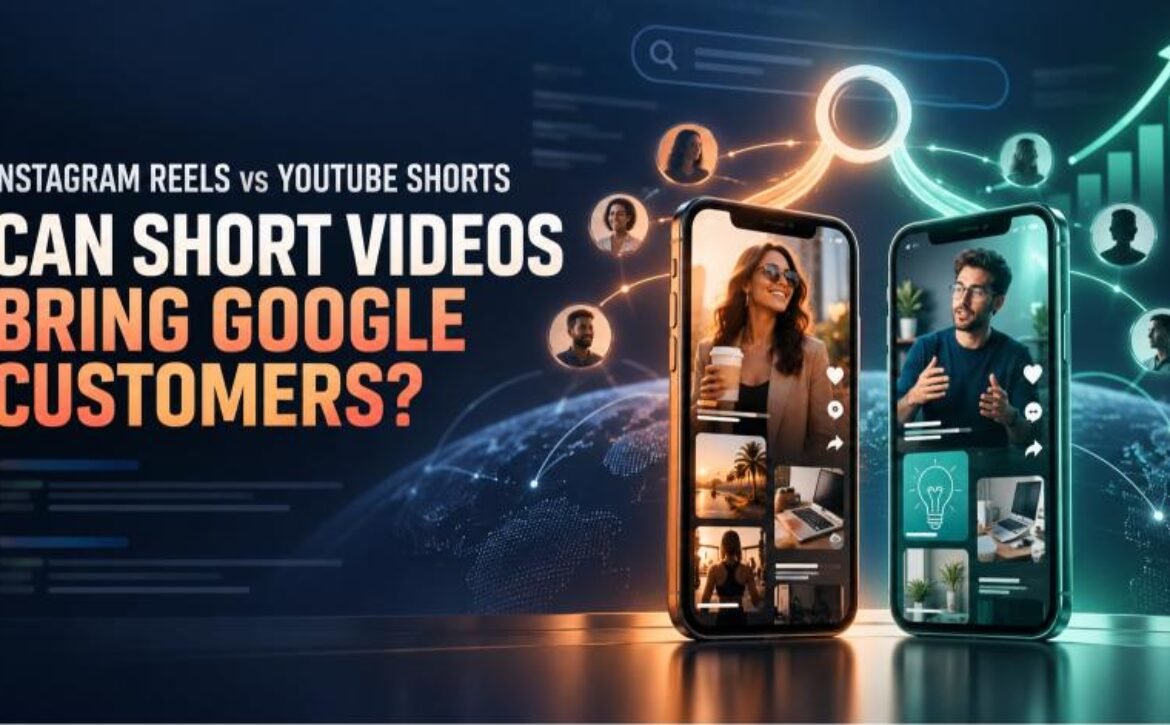
Instagram Reels vs YouTube Shorts: Which Can Bring More Customers from Google Search in 2026?

Instagram Reels vs YouTube Shorts: Which Can Bring More Customers from Google Search in 2026?

Short-form video is no longer limited to social-media feeds.

A potential customer may discover a Reel, a YouTube Short, or another social post while searching on Google. This creates a valuable opportunity for businesses: one useful video can generate visibility across more than one platform.

Google has made this shift easier to measure. In July 2026, Google announced the global availability of platform properties in Search Console. The feature allows eligible creators and publishers to understand how content from platforms such as Instagram, YouTube, TikTok, and X performs across Google Search, Discover, and Google News.

For business owners, the important question is no longer simply, “Should we make Reels or Shorts?”

The better question is:

Which format is more likely to reach the right customer, appear for relevant searches, and contribute to a genuine business enquiry?

This guide explains the differences between Instagram Reels and YouTube Shorts, how short videos can gain visibility through Google, and how businesses can build a video strategy focused on customers rather than views alone.

What Has Changed in Google Search?

Businesses have traditionally used Google Search Console to understand the performance of their websites. Google’s platform properties expand that visibility to supported social and video platforms.

According to Google, these insights can help creators and businesses:

  • Identify search queries bringing users to social and video content.
  • Discover which posts are trending up or down.
  • Detect sudden traffic increases using recent-performance data.
  • Compare performance across platforms.
  • Find older videos that are regaining search visibility.
  • Compare short-form videos with longer videos.
  • Evaluate whether changes to titles or captions affect performance over time.

This does not mean every Reel or Short will automatically rank on Google. Visibility depends on relevance, content quality, accessibility, competition, search intent, and Google’s systems. However, it does mean businesses can treat social video as part of a broader search strategy instead of viewing it only as feed content.

Can Instagram Reels Appear on Google Search?

Public Instagram content can be discovered through Google when it is accessible and considered relevant to a search. A Reel may potentially appear for searches connected with a business, location, service, product, problem, or topic.

For example, a dental clinic could publish a Reel titled:

“Three Signs You May Need a Root Canal Treatment”

A restaurant might publish:

“Best Family Dinner Experience in Indore: What to Try”

A real-estate developer could publish:

“Three Things to Check Before Buying a Plot in Indore”

These titles clearly communicate what the video is about. They are more useful for search discovery than vague captions such as “New Reel,” “Watch till the end,” or “You will not believe this.”

Instagram Reels remain especially valuable for visual discovery, social proof, brand personality, direct messages, and local engagement. A customer can watch a Reel, visit the profile, review other posts, check highlights, and send an enquiry without leaving Instagram.

Can YouTube Shorts Appear on Google Search?

YouTube Shorts can also be surfaced through Google Search. YouTube’s close connection with the wider Google ecosystem makes it a natural platform for videos designed around searchable questions and long-term discovery.

A Short answering a clear question can continue attracting viewers after the initial publishing period, particularly when its title and subject match what people search for.

Examples include:

  • “How Much Should a Small Business Spend on Google Ads?”
  • “SEO vs Meta Ads: Which Is Better for a New Business?”
  • “How to Respond to a Negative Google Review”
  • “Three Mistakes That Increase Real-Estate Lead Cost”
  • “How Long Does SEO Take to Show Results?”

YouTube Shorts can also support a wider YouTube strategy. A business can use a Short to introduce a problem and direct interested viewers to a detailed video, case study, website page, or consultation.

Instagram Reels vs YouTube Shorts: The Main Differences

Factor Instagram Reels YouTube Shorts
Primary strength Social discovery, engagement, brand personality and direct conversations Search-led discovery, educational content and connection with a broader video channel
Typical customer action Profile visit, follow, save, share or direct message Watch another video, subscribe, search the channel or visit a linked resource
Best content style Visually engaging, relatable, trend-aware and community-focused Question-led, explanatory, educational and problem-solving
Local-business value Strong for showcasing people, products, places, testimonials and daily activity Strong for answering recurring customer questions and building subject expertise
Content life Often receives the strongest response around publication, although useful content can resurface Searchable topics can continue being discovered over a longer period
Conversion path Often shorter through profile actions and DMs Often supports a longer research and trust-building journey

These are strategic tendencies, not guaranteed platform rules. Actual performance depends on the audience, industry, content, creative quality, competition, and call to action.

Which Platform Can Bring More Customers?

There is no universal winner.

Instagram Reels may be more effective when the buying decision is visual, local, emotional, or relationship-driven. This can apply to restaurants, salons, clinics, fashion brands, furniture businesses, events, hospitality, lifestyle services, and local retail.

YouTube Shorts may be more effective when customers research questions before making a decision. This can apply to healthcare education, real estate, financial education, professional services, technology, training, and B2B services.

For many businesses, the strongest approach is not Reels versus Shorts. It is a coordinated strategy in which one original vertical video is adapted appropriately for both platforms.

The subject can remain the same, but the packaging should reflect how people use each platform:

  • Instagram caption: conversational, community-focused and designed to encourage saves, shares or DMs.
  • YouTube title: clear, specific and aligned with a searchable question.
  • Website: a detailed article or service page that provides complete information.
  • Google Business Profile: a related update, image, offer, or service message when appropriate.

What Is Social Media SEO?

Social Media SEO is the practice of making social content easier to understand and discover through both platform search and external search engines.

It is not limited to adding hashtags. A search-friendly video usually communicates its subject in several places:

  • The spoken words in the video.
  • On-screen text.
  • The title or opening line.
  • The caption or description.
  • Relevant hashtags.
  • Profile and channel information.
  • The surrounding website or brand content.

If a business wants to attract people searching for “digital marketing agency in Indore,” repeatedly using that exact phrase without adding value is not a strategy. A better approach is to create videos answering genuine questions from businesses in Indore and clearly demonstrate expertise through useful information, examples, and results.

How to Create Short Videos That Can Attract Search Traffic

1. Begin With a Real Customer Question

Use questions that appear during sales calls, consultations, comments, reviews, WhatsApp conversations, or meetings.

Examples:

  • How much do Meta Ads cost for a local business?
  • Why are our leads not converting?
  • Should a new business invest in SEO or paid advertising first?
  • How can a clinic improve its Google visibility?
  • What should a customer check before buying a property?

One clear question is usually a stronger foundation than a broad video about an entire industry.

2. Make the Topic Clear Immediately

The opening seconds should tell viewers exactly what they will learn.

Instead of:

“Hello everyone, today we are back with another video…”

Use:

“Getting Meta leads but no sales? These three problems may be responsible.”

The second version communicates the problem, audience, and benefit immediately.

3. Use a Descriptive Title

A descriptive title helps users and search systems understand the subject.

Weak title:

“Marketing Tips Part 7”

Stronger title:

“Why Instagram Followers Are Not Turning Into Customers”

Avoid exaggerated claims that the video cannot support. Curiosity can improve attention, but misleading clickbait damages trust.

4. Add Useful On-Screen Text and Captions

Many people watch short videos without sound. Accurate captions make the content easier to consume and can clarify important names, locations, services, and concepts.

Keep on-screen text readable. Do not cover the entire screen with paragraphs. Highlight the central question, key steps, and final action.

5. Include Original Experience

Generic advice is available everywhere. Businesses gain credibility by including information based on real work.

Examples include:

  • A common mistake observed during campaign audits.
  • An anonymised case-study insight.
  • A before-and-after process.
  • A client question that appears repeatedly.
  • A realistic budget consideration.
  • An explanation of why a popular tactic did not work in a specific situation.

Original experience makes a video more useful and gives potential customers a reason to trust the business behind it.

6. Mention the Location Naturally When Relevant

Local businesses should make their service area clear, but location names should not be inserted unnaturally into every sentence.

A useful local topic could be:

“What Indore Businesses Should Check Before Hiring a Digital Marketing Agency”

The video can mention relevant local considerations and direct viewers to a detailed local service page.

7. Use a Business-Focused Call to Action

Views do not automatically become customers. Tell the viewer what to do next.

Depending on the goal, the call to action might be:

  • Read the complete guide on our website.
  • Send us a message for an audit.
  • Book a consultation.
  • Download the checklist.
  • View the complete case study.
  • Comment with your business challenge.

The next step should match the video topic. A person watching a detailed educational video may respond better to a related audit or guide than to a generic “Contact us now” message.

How Businesses Can Use Google Search Console for Social Content

Where platform properties are available and connected, businesses can use Search Console insights to make better content decisions.

Identify Search Themes

Review the query groups and topics associated with social or video visibility. These can reveal what prospective customers are interested in and inspire future videos, website articles, captions, and FAQs.

Find Content That Is Growing

If a recent post begins receiving more search exposure, promote it on another platform, create a follow-up, or expand the topic into a detailed article.

Revive Older Content

An older video gaining visibility may indicate renewed demand for the topic. Consider pinning it, updating related information, producing a new version, or creating “Part Two.”

Compare Platforms and Formats

Compare the performance of Instagram, YouTube, and other supported platforms. The purpose is not merely to identify which platform has the most impressions. Examine which platform attracts the right audience and contributes to website visits, conversations, calls, appointments, or qualified leads.

Record Important Changes

If you rewrite a title, improve a caption, add a clearer call to action, or update your publishing approach, record the date and review whether performance changes over time. Avoid changing several variables simultaneously if you want to understand what made the difference.

Metrics That Matter Beyond Views

A video with 100,000 views is not necessarily more valuable than a video with 5,000 highly relevant views.

Businesses should monitor:

  • Search impressions and visibility.
  • Profile or channel visits.
  • Website clicks.
  • Saves and shares.
  • Direct messages.
  • Calls and WhatsApp enquiries.
  • Appointment bookings.
  • Lead quality.
  • Cost per qualified lead when paid promotion is involved.
  • Assisted conversions across the customer journey.

Tracking should connect content performance with business outcomes. Otherwise, a brand may continue producing popular content that attracts the wrong audience.

Common Mistakes to Avoid

Posting the Same File Everywhere Without Adaptation

Cross-platform distribution is efficient, but titles, captions, calls to action, and supporting context should be adapted for each platform.

Chasing Trends Unrelated to the Business

A trend may generate views without building relevance or trust. Use trends only when they can connect naturally with the audience’s needs and the brand’s expertise.

Using Vague Titles

Titles such as “Big News,” “Must Watch,” or “Our Latest Reel” provide very little context. Use words that describe the actual question, solution, service, or location.

Copying Content Without Adding Value

Reposting or lightly editing another creator’s work does not demonstrate expertise. Build original videos or add substantial analysis, explanation, evidence, or experience.

Optimising for Views Instead of Customers

Entertainment and reach can support brand growth, but every business content plan needs a connection to awareness, trust, enquiry, or conversion.

Expecting Guaranteed Google Rankings

No agency or creator can guarantee that a Reel or Short will appear in a particular Google position. Optimisation improves clarity, relevance, quality, and discoverability; final visibility is determined by the platform’s systems.

A Practical Video Strategy for Businesses

A simple monthly system could look like this:

  1. Collect 12 real customer questions.
  2. Select four high-intent topics connected with your services.
  3. Record four original vertical videos.
  4. Publish adapted versions on Instagram and YouTube.
  5. Support the strongest topic with a detailed website article.
  6. Link the content to the most relevant service page or enquiry action.
  7. Review search visibility, engagement, website behaviour, and leads.
  8. Turn the strongest topic into a follow-up series.

This approach creates a connected content ecosystem instead of a collection of unrelated posts.

Should Your Business Focus on Instagram Reels or YouTube Shorts?

Choose Instagram Reels first when:

  • Your customers are highly active on Instagram.
  • Your product or service is visually driven.
  • Direct messages are an important conversion channel.
  • Local awareness and social proof influence buying decisions.
  • Your brand benefits from people, personality, and behind-the-scenes content.

Choose YouTube Shorts first when:

  • Customers frequently search for answers before contacting you.
  • Education and expertise are important to the buying decision.
  • You already create long-form YouTube content.
  • You want to build a searchable video library.
  • Your service requires trust over a longer decision cycle.

Use both when you can maintain quality and adapt the content properly. A strong original video can serve different stages of the customer journey across Instagram, YouTube, Google, and your website.

How Sampark Sutra Can Help

Effective video marketing requires more than filming and uploading Reels.

The content must connect customer research, creative production, search visibility, platform strategy, conversion paths, and performance measurement.

Sampark Sutra helps businesses with:

  • Social media strategy and management.
  • Instagram Reels planning and production.
  • YouTube Shorts and video content.
  • UGC content creation.
  • Search Engine Optimisation.
  • Social Media SEO and video optimisation.
  • Google and Meta advertising.
  • Lead-generation campaigns.
  • Graphic design and video editing.
  • Website and landing-page development.
  • Analytics, tracking, and conversion optimisation.
  • Digital PR and brand communication.

Established in 2019, Sampark Sutra focuses on converting digital visibility into relevant business enquiries. Our approach combines content, search, social media, paid advertising, and creative communication according to the customer journey.

Conclusion

Instagram Reels and YouTube Shorts can both create opportunities for discovery beyond their native feeds. The better platform depends on the business, audience, topic, and conversion path.

Instagram is often powerful for visual discovery, community engagement, social proof, and direct conversations. YouTube is often powerful for searchable education, topic authority, and a longer video journey. Google’s new social and video performance insights give businesses a better way to understand how this content is discovered through search.

The winning strategy is not to publish more random videos. It is to answer real customer questions, create original and useful content, describe each video clearly, connect it with the right business action, and measure outcomes beyond views.

When SEO, social media, video production, and lead tracking work together, a short video can become more than a post. It can become a long-term customer-discovery asset.

Request a Free Social Media and Video SEO Audit

Are your Instagram Reels and YouTube Shorts attracting the right audience—or only generating views?

Contact Sampark Sutra for a professional review of your social content, video SEO, website journey, and lead-generation strategy.

Sampark Sutra – Digital Marketing & PR Agency
Call/WhatsApp: +91 90092 44488
Email: sampark@samparksutra.in
Website: www.samparksutra.in

Frequently Asked Questions

1. Can Instagram Reels rank on Google?

Public Instagram content may appear in Google when it is accessible, relevant, and selected by Google’s systems. Clear topics, useful information, descriptive captions, and an established brand presence can improve understanding and discoverability, but rankings cannot be guaranteed.

2. Are YouTube Shorts better than Instagram Reels for SEO?

YouTube Shorts are often well suited to searchable questions and educational topics. Instagram Reels can also gain search visibility and may offer a shorter route to profile visits and direct messages. The better choice depends on the audience and business objective.

3. Should the same video be posted on Instagram and YouTube?

An original vertical video can be used on both platforms, but its title, caption, call to action, and supporting context should be adapted. Avoid publishing a poorly presented copy with irrelevant platform elements or watermarks.

4. Do hashtags help videos appear on Google?

Relevant hashtags may provide useful context on social platforms, but they are only one small part of discovery. The topic, spoken content, title, caption, audience response, originality, and overall relevance matter more than adding a large number of hashtags.

5. How can a business measure whether short videos generate customers?

Track website visits, tagged campaign links, calls, WhatsApp enquiries, direct messages, appointment bookings, forms, and lead quality. Search Console and platform analytics can show visibility and engagement, while website analytics and CRM data help connect activity with enquiries and sales.

6. How often should a business publish Reels or Shorts?

There is no single ideal frequency. A consistent schedule of useful, original videos is better than publishing frequently without a clear audience or purpose. Begin with a manageable plan, evaluate performance, and increase production when the process is sustainable.

Read More
admin September 7, 2026 0 Comments

How to Make Your Business Visible in Google AI and ChatGPT Search

The way people search for businesses is changing rapidly.

Earlier, a potential customer would search for phrases such as “best digital marketing agency in Indore,” visit a few websites, compare services, and then contact an agency.

Today, the same customer may ask Google or ChatGPT:

  • Which digital marketing agency in Indore is suitable for lead generation?
  • Should a clinic invest in SEO or Instagram Ads?
  • What is the best marketing strategy for a real estate project?
  • Which agency can manage social media, content, paid advertising, and PR?
  • How much should a small business spend on digital marketing?

Instead of displaying only a list of links, AI-powered search tools can now generate direct answers, comparisons, and recommendations.

This means that businesses should no longer focus only on appearing on the first page of traditional Google Search. They must build an online presence that search engines and AI platforms can easily understand, trust, and reference.

The good news is that businesses do not need secret tricks to appear in AI-powered search results. The foundation remains the same: useful content, clear business information, strong SEO, genuine expertise, and a trustworthy digital presence.

In this guide, we will explain how Google AI Overviews, AI Mode, and ChatGPT Search work, along with the practical steps businesses can take to improve their visibility in 2026.

What Is AI Search?

In traditional search, a user enters a keyword and receives a list of relevant websites.

AI Search allows users to ask longer, conversational, and more specific questions. The AI system gathers information from relevant sources and provides a summarized answer. It may also display supporting websites and clickable links.

For example, instead of searching for:

“Digital marketing agency Indore”

A customer may ask:

“Which digital marketing agency in Indore has experience in generating leads for real estate businesses?”

The second query is more detailed and shows stronger buying intent.

AI-powered search is designed to understand the meaning behind such questions. It can compare information from multiple sources and help the user make a decision faster.

Google has clarified that websites do not need special AI-specific schema or secret optimisation methods to appear in AI Overviews or AI Mode. A website must still be accessible, indexed, useful, and relevant.

In simple terms, SEO is not disappearing. Its role is becoming broader.

Are SEO and AI Search Optimisation Different?

You may have heard terms such as:

  • AEO: Answer Engine Optimisation
  • GEO: Generative Engine Optimisation
  • AI SEO
  • AI Search Optimisation

These terms generally describe the process of making content easier for AI-powered search platforms to understand and reference.

However, businesses should not treat SEO and AI visibility as two completely separate strategies.

Google’s AI search features still rely on indexed web content and its core search systems. Therefore, technical SEO, useful content, website authority, accurate information, and internal linking remain important.

AI Search Optimisation does not mean repeating keywords throughout a page. It means:

  • Answering the customer’s actual question clearly.
  • Demonstrating genuine experience and expertise.
  • Supporting information with practical examples.
  • Keeping business details accurate and consistent.
  • Creating content that is useful beyond basic information.
  • Making the website easy for search engines and AI crawlers to access.

What Are the Benefits of AI Search Visibility?

1. Reach High-Intent Customers

People often use AI platforms when they need recommendations, comparisons, or solutions.

For example:

“Which digital marketing agency can help my real estate business generate qualified leads?”

Someone asking this question may already be close to hiring an agency.

If your business is mentioned or referenced in the answer, you may receive a highly relevant potential customer rather than a casual website visitor.

2. Build Brand Authority

When your website is used as a supporting source in an AI-generated answer, it can strengthen your credibility.

The user may feel that your business has sufficient knowledge and expertise on the subject. Even when the user does not contact you immediately, repeated visibility can improve brand recognition.

3. Gain Visibility Beyond Traditional Search

Customers now move between Google Search, Google Maps, YouTube, Instagram, WhatsApp, ChatGPT, and other platforms.

A strong digital presence allows your business to be discovered at different stages of the customer journey, rather than relying on a single channel.

4. Generate Long-Term Organic Opportunities

Paid advertising can stop producing traffic when the advertising budget is paused.

However, high-quality service pages, blogs, case studies, and local landing pages can continue attracting visitors and enquiries for a longer period.

How Can Your Business Appear in Google AI Overviews and AI Mode?

1. Create Helpful and Original Content

Rewriting information that is already available across hundreds of websites is unlikely to make your content stand out.

AI systems already have access to large amounts of general information. What they need are reliable sources that provide unique insights, practical experience, and clear answers.

Instead of publishing another general article titled:

“What Is Digital Marketing?”

A business can publish a more useful article such as:

“How Should a Small Business Divide a ₹30,000 Monthly Budget Between SEO, Social Media, and Paid Ads?”

This topic provides a specific solution to a real business problem.

The article can include:

  • A practical budget breakdown.
  • Realistic expectations.
  • Common spending mistakes.
  • Recommended marketing channels.
  • Performance metrics that should be monitored.
  • Situations in which the budget should be increased.

An experienced agency such as Sampark Sutra can also add first-hand insights, including:

  • Why some lead-generation campaigns fail.
  • How lead quality differs across industries.
  • How long a business should wait before evaluating results.
  • The difference between advertising spend and agency fees.
  • Which metrics are genuinely connected with sales.

This type of knowledge makes content more valuable than a generic summary.

2. Create Content Around Real Customer Questions

Blog topics should not be selected only according to keyword volume.

Businesses should also consider the questions that customers repeatedly ask during:

  • Sales calls
  • WhatsApp conversations
  • Client meetings
  • Proposal discussions
  • Social-media comments
  • Customer-support interactions

Common questions may include:

  • How much does a digital marketing agency charge?
  • How long does SEO take to produce results?
  • Why do Instagram followers not convert into enquiries?
  • Are Google Ads better than Facebook Ads?
  • How can a real estate company generate qualified leads?
  • How should negative Google reviews be handled?
  • Can AI-generated website content affect SEO?
  • How much advertising budget does a small business need?

Every genuine customer question can become a useful blog topic.

This approach also helps a company create content that sounds natural because it addresses problems that real people are already experiencing.

3. Create a Detailed Page for Every Important Service

Listing every service briefly on the homepage may not be enough for search engines or AI platforms to understand your expertise.

Create a separate and detailed page for each important service, such as:

  • Search Engine Optimisation
  • Social Media Marketing
  • Google Ads Management
  • Meta Ads Management
  • Website Development
  • Video Production
  • UGC Content Creation
  • Online Reputation Management
  • Public Relations
  • Local SEO Services

Every service page should clearly explain:

  • Who the service is designed for.
  • What business problem it solves.
  • How the process works.
  • What deliverables are included.
  • How performance will be measured.
  • What experience or proof the company has.
  • What the customer should do next.

Avoid creating extremely short service pages that only contain promotional statements.

A useful service page should help the visitor understand whether the service is suitable for their business.

4. Make Your Business Identity Clear

Search engines and AI platforms should be able to understand:

  • Who you are.
  • Where your business is located.
  • Which services you provide.
  • Which industries you serve.
  • How customers can contact you.
  • Why your company is credible.

Keep the following information complete and consistent:

  • Business name
  • Office address
  • Service locations
  • Contact number
  • Official email address
  • Website URL
  • Services
  • About page
  • Founder or team information
  • Social-media profiles
  • Google Business Profile

For Sampark Sutra, the website should clearly communicate that the agency has been operating since 2012 and provides services including SEO, social media marketing, lead generation, content production, website development, UGC, and public relations.

Experience should not be presented only through statements such as “We are the best.”

It should be supported with:

  • Work samples
  • Case studies
  • Campaign results
  • Client testimonials
  • A clear working process
  • Industry experience
  • Practical insights

5. Optimise Your Google Business Profile

A Google Business Profile is particularly important for local searches and nearby business recommendations.

Make sure the profile includes:

  • The correct business category.
  • A complete business description.
  • Accurate contact details.
  • Updated working hours.
  • Website link.
  • Office address or service area.
  • Services.
  • Original photographs.
  • Regular business updates.
  • Customer reviews.

Businesses should request genuine reviews from satisfied customers.

A review that naturally describes the service and customer experience is more useful than a review containing only phrases such as “good service” or “best company.”

Businesses should also respond professionally to every review, including negative ones.

A thoughtful response shows potential customers that the company takes feedback seriously.

6. Publish Case Studies and Measurable Results

In AI-powered search, proof is more valuable than a promotional claim.

Saying “We generate leads” is a general statement.

A useful case study should explain:

  • Which industry the client belonged to.
  • What problem the client was facing.
  • What strategy was implemented.
  • Which marketing channels were used.
  • How long the campaign ran.
  • How lead quality was evaluated.
  • What measurable improvement was achieved.

If client confidentiality is a concern, an anonymised case study can still be published.

For example:

“How We Improved Lead Quality for a Premium Real Estate Project”

This type of content helps potential clients understand your strategy, knowledge, and problem-solving process.

It can also provide search engines and AI systems with clear evidence of your expertise.

7. Provide Clear and Direct Answers

Content does not need to be divided into unnatural, extremely short sections for AI systems.

However, a clear structure makes the information easier for both readers and search systems to understand.

A blog should include:

  • Descriptive headings
  • Short paragraphs
  • Step-by-step explanations
  • Relevant examples
  • Comparison tables where necessary
  • Frequently asked questions
  • A summary or checklist
  • Descriptive image captions

A heading can be written as a customer question, followed by a direct answer.

For example:

How Long Does SEO Take to Produce Results?

Meaningful organic improvement may take several months for many businesses. The exact timeline depends on the website’s current condition, competition, industry, location, technical issues, and content quality. A professional agency should not promise a guaranteed ranking within a fixed period.

This answer is natural, useful, and realistic.

8. Make Sure Your Website Can Be Crawled and Indexed

Excellent content cannot perform well if search engines cannot access it.

Businesses should check whether:

  • Important pages are blocked in robots.txt.
  • A noindex tag has been added accidentally.
  • The XML sitemap is working correctly.
  • The website is verified in Google Search Console.
  • The mobile version works properly.
  • Important links are not broken.
  • Pages load at a reasonable speed.
  • Important content is accessible to crawlers.
  • Canonical tags are correctly implemented.
  • HTTPS is active.

For a page to be considered for Google’s AI search features, it must generally be indexed and eligible to appear with a search snippet.

Technical SEO should therefore be treated as the foundation of AI visibility.

9. Do Not Block OAI-SearchBot

According to OpenAI, public websites may appear in ChatGPT Search.

To help content get discovered, cited, and linked, businesses should ensure that OAI-SearchBot is not blocked through the website’s robots.txt file.

This technical check can be completed by an SEO professional or website developer.

OAI-SearchBot and GPTBot do not serve exactly the same purpose. Website owners may manage their crawling preferences separately.

Businesses can also track traffic coming from ChatGPT through website analytics. OpenAI states that referral links from ChatGPT may include the utm_source=chatgpt.com parameter.

This allows businesses to identify how many users are reaching their website through ChatGPT search results.

10. Use Original Images and Videos

Search and AI discovery are not limited to written content.

High-quality images and videos can create additional opportunities for visibility.

A business website can include:

  • Original office photographs
  • Team photographs
  • Product images
  • Project photographs
  • Before-and-after examples
  • Client-approved campaign creatives
  • Short educational videos
  • Customer testimonials
  • Process videos
  • Founder or expert insights

Image filenames and alt text should describe the image accurately.

Videos should have a clear title, description, and supporting text so that search systems can understand their context.

Avoid filling a website with generic stock images that do not represent the actual company, service, or customer experience.

11. Display the Author’s Expertise

Knowledge-based articles should include the author’s name or the team responsible for the content.

A short author description may look like this:

About the Author:
This article has been prepared by the digital marketing team at Sampark Sutra. Established in 2012, Sampark Sutra helps businesses with SEO, social media marketing, lead generation, content production, website development, and public relations.

Wherever possible, articles should include practical experience, original observations, and professional judgement.

AI tools can assist with research, structure, and drafting. However, content should be reviewed by a knowledgeable person before publication.

Publishing large volumes of unreviewed AI-generated content is not a sustainable SEO strategy.

Google has stated that generative AI can be useful for research and content structure. However, generating many pages without adding meaningful value may violate its policies concerning scaled content abuse.

12. Update Important Content Regularly

Changing only the publication date does not make an old article current.

When updating a blog, check:

  • Whether platform features have changed.
  • Whether statistics are still accurate.
  • Whether screenshots are outdated.
  • Whether new FAQs should be added.
  • Whether a new case study is available.
  • Whether service information has changed.
  • Whether internal links need to be updated.
  • Whether customer behaviour has changed.

Important blogs should be reviewed periodically to ensure that the information remains useful and accurate.

What Should Businesses Avoid?

Keyword Stuffing

Repeating the same keyword unnaturally does not improve the quality of an article.

Search engines can understand context, related terms, and meaning. Content should be written for the reader, not only for an algorithm.

Creating a Separate Page for Every Keyword Variation

Businesses do not need nearly identical pages for:

  • Digital marketing agency Indore
  • Best digital marketing agency in Indore
  • Top marketing agency Indore
  • Digital agency near me

A single detailed, useful, and well-structured page may perform better than several low-value pages targeting slightly different keyword variations.

Fake Reviews and Artificial Mentions

Fake reviews, spam links, and misleading business mentions may appear attractive as shortcuts.

However, they can damage brand trust and may create long-term search and reputation problems.

Publishing AI Content Without Human Review

AI can help create a first draft, but it cannot automatically replace business experience, accuracy, judgement, and brand voice.

Every article should be checked for:

  • Factual accuracy
  • Originality
  • Tone
  • Practical usefulness
  • Industry relevance
  • Grammar
  • Outdated information
  • Unnecessary repetition

Guaranteed AI Rankings

No genuine agency can guarantee that a business will always be mentioned in a specific AI-generated answer.

A professional strategy can improve website quality, relevance, discoverability, and authority. However, the final selection of sources is controlled by the respective search or AI platform.

Practical AI Search Visibility Checklist

Use this checklist to evaluate your current online presence:

  • Is your website indexed by Google?
  • Is Google Search Console properly configured?
  • Does every important service have a dedicated page?
  • Are the About and Contact pages complete?
  • Is your Google Business Profile updated?
  • Does your website contain original blogs and case studies?
  • Are customer questions answered clearly?
  • Is your business name, phone number, and address consistent across platforms?
  • Do you have genuine customer reviews?
  • Is your website mobile-friendly?
  • Does your website load properly?
  • Is OAI-SearchBot allowed to access relevant pages?
  • Does your website contain original images or videos?
  • Is important content reviewed and updated?
  • Are traffic, enquiries, calls, and conversions being tracked?

If the answer to several of these questions is “no,” your business may need a structured AI visibility and SEO strategy.

How Can Sampark Sutra Improve Your AI Search Visibility?

AI Search visibility cannot be achieved through a single plugin or setting.

It requires a combined strategy involving:

  • Technical SEO
  • Website structure
  • Content quality
  • Local presence
  • Brand authority
  • Customer reviews
  • Case studies
  • Conversion optimisation
  • Performance tracking

Sampark Sutra can support businesses with:

  • Website and SEO audits
  • Keyword and customer-question research
  • AI Search-ready content strategy
  • Service-page optimisation
  • Knowledge-based blog creation
  • Google Business Profile optimisation
  • Local SEO
  • Technical SEO coordination
  • Case-study development
  • Image and video content
  • Website analytics
  • Lead tracking
  • Conversion optimisation

Established in 2012, Sampark Sutra focuses on more than website traffic. Our objective is to help businesses reach a relevant audience and convert digital visibility into genuine business enquiries.

Conclusion

The basic principle of digital marketing has not changed because of AI Search.

Businesses must understand their customers’ problems and provide information that is useful, trustworthy, and easy to understand.

What has changed is how that information is discovered.

Your content is now being interpreted not only by human visitors, but also by search engines and AI systems. Therefore, accurate business information, original expertise, structured service pages, customer reviews, case studies, and technical accessibility have become even more important.

Businesses that start building their digital authority today will have a stronger opportunity to gain visibility across Google Search, Google Maps, AI Overviews, AI Mode, and ChatGPT Search.

Request a Free AI Visibility Audit

Is your business ready to appear in Google and AI-powered search results?

Contact Sampark Sutra for a professional review of your website, SEO, content, and local digital presence.

Sampark Sutra – Digital Marketing & PR Agency
Call/WhatsApp: +91 90092 49488
Email: sampark@samparksutra.in
Website: www.samparksutra.in

Frequently Asked Questions

1. Can a Business Rank in ChatGPT Search?

ChatGPT Search does not have a fixed ranking system identical to traditional Google results. A useful, accessible, and trustworthy website may improve its chances of being discovered and cited. However, inclusion cannot be guaranteed.

2. Will AI Search Replace SEO?

No. Google has confirmed that foundational SEO practices remain relevant to its AI search features. Crawlability, indexing, content quality, authority, and user experience will continue to matter.

3. Can AI-Generated Content Rank on Google?

AI can be used for research and drafting. However, the final content should be useful, accurate, original, and created for people. Publishing large amounts of low-value content without human review may negatively affect performance.

4. How Long Does AI Search Optimisation Take?

There is no fixed timeline. Results depend on the website’s technical condition, existing authority, competition, content quality, industry, and consistency. AI visibility should be treated as a long-term digital authority strategy.

5. Do Small Local Businesses Need AI Search Optimisation?

Yes. Customers increasingly use AI platforms to discover nearby clinics, restaurants, agencies, stores, professionals, and service providers. Accurate local information, customer reviews, service pages, and useful content can help a local business build stronger visibility.

Read More
admin August 24, 2026 0 Comments

Case Study: Immersive 360° Property Mapping for Real Estate Plotting Township

How Immersive 360° Property Mapping Accelerated Sales for a Premium Plotting Township in Indore

📌 Introduction 

Discover how Sampark Sutra eliminated physical site visit dependencies and travel constraints for a premium real estate plotting project. By deploying high-definition 360° interactive mapping built with 100% actual site captures, we enabled anytime-anywhere virtual tours that drastically compressed decision cycles and unlocked massive NRI/out-of-city investor trust.

❌ 1. The Challenge: Time Mismatches & Remote Trust Deficit

Selling premium residential or investment plots involves heavy decision-making, where location visualization is everything. The project faced major operational roadblocks:

  • Severe Time Mismatches: Busy buyers struggled with tight schedules. Coordinating site visits during the week was nearly impossible, and traveling to suburban locations on weekends severely restricted them to exploring just one property a day.
  • The Distance Barrier: Out-of-city buyers and NRI investors showed high initial interest but hesitated to move forward due to a lack of visual transparency. Traditional 2D blueprints or generic 3D renders failed to capture the actual on-ground reality.

🛠️ 2. Our Strategy: 100% Transparent Actual Visual Funnels & AR/VR Hybrid Deployments

Sampark Sutra designed a multi-channel visual strategy tailored to bring the actual plotting site directly to the buyers’ screens, transforming real estate marketing from a physical hassle into a digital experience:

  • 100% Actual Image Mapping (Zero 3D Fiction): Unlike standard campaigns that use artificial 3D blueprints, we mapped the entire township using high-resolution actual site pictures. This gave buyers unfiltered transparency regarding boundaries, road widths, and exact unit positions (such as garden-facing plots).
  • Anytime, Anywhere Virtual Walkthroughs: We integrated a highly responsive, cloud-hosted 360° interactive tracking interface (Powered by Kuula platform) right into the project layout. Prospects could evaluate and “walk” the entire layout from any device, at any hour of the day, completely eliminating the scheduling bottleneck.
  • Immersive AR/VR Headset Alignment: For an elevated sensory experience, the platform was optimized for AR/VR headsets. Putting on a headset provided a 1:1 scale simulation, making users feel as if they were physically standing on their specific plot of interest.
  • Print-to-Digital Funnel via QR Codes: To bridge offline newspaper advertisements with digital immersion, we generated custom QR codes. Readers scanning the print ad were instantly teleported into the interactive township tour right from their smartphones.
  • High-Intent Meta Lead Gen Funnels: We directly embedded the immersive 360° virtual tour link within targeted social media campaigns. Buyers interacting with the Meta ads were instantly guided into the tour, helping them form an immediate opinion and simplifying their final decision.

Live Interactive Blueprint Integration


📈 3. The Final Factual Result: Instant Trust Validation & Shorter Booking Windows

By introducing an interactive blueprint, the plotting project achieved remarkable organic traction and trust transparency:

  • Accelerated Remote Closures: NRI and out-of-city investors gained full visual confidence in the plot’s actual look and surroundings. This eliminated months of hesitation, enabling fast remote investment decisions without requiring a physical visit.
  • Eliminated Scheduling Bottlenecks: Buyers no longer had to wait for matching weekend windows. Township walkthroughs were conducted “anytime, anywhere,” effectively shortening the property selection window from several weeks to mere days.
  • Massive Boost in Global Interest: Integrating actual site imagery led to a massive spike in qualified domestic and overseas inquiries, maximizing the brand’s overall visibility.

💡 4. Sampark Sutra’s Insider Pro-Tip for Immersive Township Shoots

When executing 360° mapping for vast open plotting spaces, ensure the stitching captures are done under uniform natural daylight rather than harsh midday sun. This keeps overall horizon luminance balanced, avoiding sharp playground shadows and preventing eye fatigue for buyers using high-density AR/VR headsets during prolonged virtual walkthroughs.

Read More
admin June 5, 2026 0 Comments